Across the fields to Israel: The story of a lift (‘tremp’) and the revelation of The Bachad Farm Institute, Thaxted (1944-1962)

I count myself extremely fortunate to have had the opportunity to spend nearly a year in Israel, working as a violinist in the Kibbutz Chamber Orchestra (1987- 1988). The initial shock and steep learning curve of finding myself living on a small kibbutz (Mishmarot, near Pardes Hanna) paved the way for a truly enriching and deeply-affecting experience. Not only was I exposed to significant history, much of which I had been largely ignorant, but I got to know people and their personal histories at first hand. Many of my colleagues in the orchestra had stories to tell and so did members of the ‘big family’ of the kibbutz. The opportunity to live and work amongst these people - from diverse backgrounds - had come hard on the heels of two years I had spent working in a Christian centre of reconciliation in Northern Ireland. I had exchanged one troubled part of the world for another, it seemed. The Irish experience had begun to teach me to listen at a deeper level, to be sensitive to the pain of the past, and begin to perceive how this plays out in the complexities of the present. In the Israeli context this was taken to a new level.
The arrangement between the Kibbutz Chamber Orchestra and Kibbutz Mishmarot was I and fellow violinist Liebet from the Netherlands would be provided with board and lodging and in return, we would be employed for two to three days in the orchestra, but also work on the kibbutz. Every Tuesday morning at 7.a.m. a taxi would collect the two of us to ferry us down to Kibbutz Shefayim north of Tel Aviv, where we would join other musicians drawn from kibbutzim throughout the country for two days’ intensive rehearsal. Our concerts took place throughout the length and breadth of the country – mostly, but not exclusively, in kibbutzim.


The kibbutz lifestyle left me reeling to start with – as did the August heat! As well as the orchestral work, my usual kibbutz job was ironing shirts for seven hours a day! (Photo: Verity and co-worker in the machsan, Mazal (originally from Egypt)
From this work - which I hasten to add, I really enjoyed - I was released for one day per week to give piano lessons to members of the kibbutz. A couple of these adult students spoke very little English, so the kibbutz management decided that I should receive Hebrew tuition (one hour a week) from an elderly member, Rachel Tal (ז"ל) (originally from Russia, pictured to the right). Thus began my love of the Hebrew language which continues to this day.
After a few months in the orchestra, one of my fellow violinists encouraged me to join a fledgling baroque ensemble in Jerusalem (now the Jerusalem Baroque Orchestra). No taxis came to pick me up for this, however. I had to brave public transport, which in those days was not a simple matter, especially not for a single female in her twenties, travelling alone. It was during one of these return journeys to Mishmarot that I had an unexpected encounter.

It was a dark winter’s night, late December, 1987, and due to the outbreak of the First Intifada, there was a troubling sense of tension and unease in the air; I was dreading the prospect of walking the two kilometres from Pardes Hanna bus station to Mishmarot on my own. There were no street lights back then, and the lane passed by a cemetery and was straddled by densely planted orchards. Since I hadn’t enough money for a taxi, I had no choice but to set out with violin slung over the shoulder and heart in mouth, praying very hard!
I must have walked about 200 metres when I heard a vehicle approach from behind and - to my horror - it drew to a halt beside me! I clearly recall being able to hear my heart pounding heavily in my chest as a multitude of fearful thoughts flooded my mind.
The driver called out – in English - through the open car window, “You want a lift?”
He later admitted that I didn’t look very Israeli! He had a marked accent, but to my relief, it was a European/Israeli one. I tried to assess the situation. Was he genuine? The man appeared to be mature – in his fifties at least, as far as I could see, so I decided to take the risk.
“Yes, to Mishmarot”, I replied.
I made my way over to the passenger door, opened it and gingerly clambered in, placing my violin between myself and the gear stick - a barrier of sorts might prove useful, I thought.
“Where are you from?” he asked in a very direct manner.
With some hesitation, I answered, “England”.
“Ah, I worked in England for a number of years. Whereabouts in England?”
“Do you know an area north-east of London called Essex?”
“Yes, of course! I went there regularly. Where do you come from in Essex?”.
At this point I wondered if he was making up this story to gain some kind of rapport with me, so I cagily mumbled something and returned to my defensive silence. However, he was having none of this, he continued,
“This is really important to me – I must know exactly where you grew up!”
To this I replied, “I’m sure you won’t have heard of the village – and anyway, we didn’t even live in the village, we lived two and a half miles outside. The village is called Thaxted”.
At this point he became excited, exclaiming, "That's where the farm was!". He had been a regular visitor to this farm, as his then fiancée was training there!
He then proceeded to relate how, during the Second World War, a small Jewish organisation called Bachad had purchased the farm just outside Thaxted – the Thaxted Lodge Farm. I knew this farm well. In fact, I could see it across the fields from the bedroom window of my childhood home! He went on to explain that this farm served as a training farm institute for young Jewish men and women, furnishing them with agricultural skills prior to them making ‘Aliyah’ to Israel. I was flabbergasted! I knew nothing of this history, and so close to my family home, too! It was unbelievable to me that, given the close, rural community we lived amongst, that nobody had mentioned anything about this. The driver continued:
“Do you know the name, Stanley Tatum?”
The mention of this name filled me with relief and joy! There was no way this driver could have made up this story if he knew Stanley Tatum! (not a name one would forget in a hurry).
“Yes, I know the name, but I don’t know him personally” I replied.
“Mr. Tatum was our ‘pig man’!”
He chuckled, going on to explain that of course, being a Jewish farm, there were definitely no pigs, but that Mr. Tatum was employed to do the milking on Shabbat! (Maybe he was testing my knowledge of Jewish Torah Law, here?)
As he pulled up outside the kibbutz entrance, I thanked him sincerely for his kindness. He admitted that he was concerned to see a young lady on her own in the dark, and that since he had business to attend to at the Tal Wood Factory next to the kibbutz, he was all too pleased to help. He did mention his name – his surname, Sharon, I was told, I would be able to remember, as it was the same as that of well-known politician of that time, Ariel Sharon, and his first name, Yitzhak, happened to be the same as that of the then Prime Minister, Yitzhak Shamir. With that, he proceeded on his journey and I - now in a euphoric daze - to my kibbutz dwelling.
I found myself reflecting on how incredible it was that the one and only time I had ever accepted a lift in Israel, I should be brought into contact with a man, who, thirty or more years before, had spent time less than a mile from my home, some two and a half thousand miles away! I felt comfortably reassured. The Almighty was obviously looking after me.
The remainder of my stay in Israel continued to make a deep impression, but as I could not afford to continue in my volunteer status beyond the summer of 1988, I felt I had to get back home to start looking for work. So it was with a heavy heart I left for the U.K. to return to sleepy rural Essex.
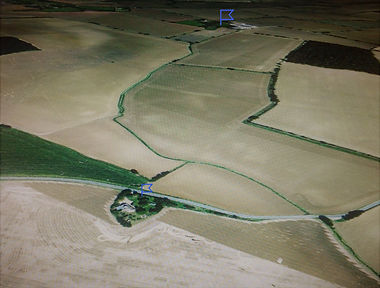
Each morning, following my arrival back home, I was greeted by the same familiar pastoral view and in the distance, yes, the Thaxted Lodge Farm. But the idea of following up my discovery of its Jewish past was the last thing on my mind. Anyway, who would be interested? I did mention the incident of the lift to my mother, though – she admitted to having known that Jewish people had been at the farm, but since they had left in 1962, she had seen no reason to mention it to us as children.
(Photo: Verity's home, bottom left; Bachad Farm, top right.)
We didn’t have Internet in those days, and I didn't have the first clue about historical research at that juncture. Anyway, I applied myself to the task of applying for jobs, and consequently forgot about the ‘tremp’ in Israel and the farm.
Years passed, but I could not forget my time in Israel. Part of my heart had been left behind. I did my best to keep learning - pecked away at the Hebrew, read books and attended lectures when I could. I became a member of the Council of Christians and Jews and other organisations providing information and support to Israel - and another called Musalaha, working for reconciliation between Israelis and Palestinians. In 1996, job relocation brought me to Cosham, near Portsmouth and with it came the opportunity to connect with the Parkes Institute at the University of Southampton and to attend its seminars and lectures on Jewish history. An excellent Hebrew teacher - Mrs Ori Glaser - helped me prepare for 'A' levels in both Modern and Biblical Hebrew.
Sadly, by 2010 my late father was suffering from dementia. As I was searching Google for items connected to Thaxted to help stimulate his memory, up popped an amazing image entitled ‘Morning prayers at Bachad Farm Institute, Thaxted’! For copyright reasons, the image can’t be posted here, but you can preview it:
The memory of the ‘tremp’ came flooding back! With my expanding knowledge, I now had more of an idea of the questions I needed to ask and how the Thaxted farm was likely to figure within the wider context of the flight of refugees from Nazism and their desire to contribute to a Jewish state. So began my Bachad research in earnest!
The journey has been a long one - and not without significant challenges. The path I have been on, the interactions with people and all I have learned has certainly changed my life! Having conducted over one hundred interviews and having met many more folk than that with connections to Bachad, I now am faced with the challenge of writing a book, which I hope will be hybrid in nature – useful for academics as well as accessible for the people who were involved in the movement and their descendants. Watch this space!
Postscript: I was eventually put in touch with Yitzhak Sharon (the driver who gave me the lift). We spoke on the phone a couple of times, although sadly, he seemed mentally confused and couldn’t remember having given me the lift, so would not agree to a meeting. Following his passing, however, I was able to meet members of his family - who remembered Yitzhak mentioning that he’d given a lift to an English lady from Thaxted!
Without Yitzhak’s act of kindness that fearful December night in 1987, I may have remained forever ignorant of the existence of the Bachad Farm Institute! Now, my gratitude is multiplied many times over for all that this chance encounter opened up and above all, the chance to get to meet so many lovely people with important stories to tell. A big "Thank you!" to everyone who has contributed in a multitude of ways! I will do my utmost to do justice to documenting this history for posterity.

Verity's visit to Irene (ז"ל) and Shlomo Manns, 2017, Israel